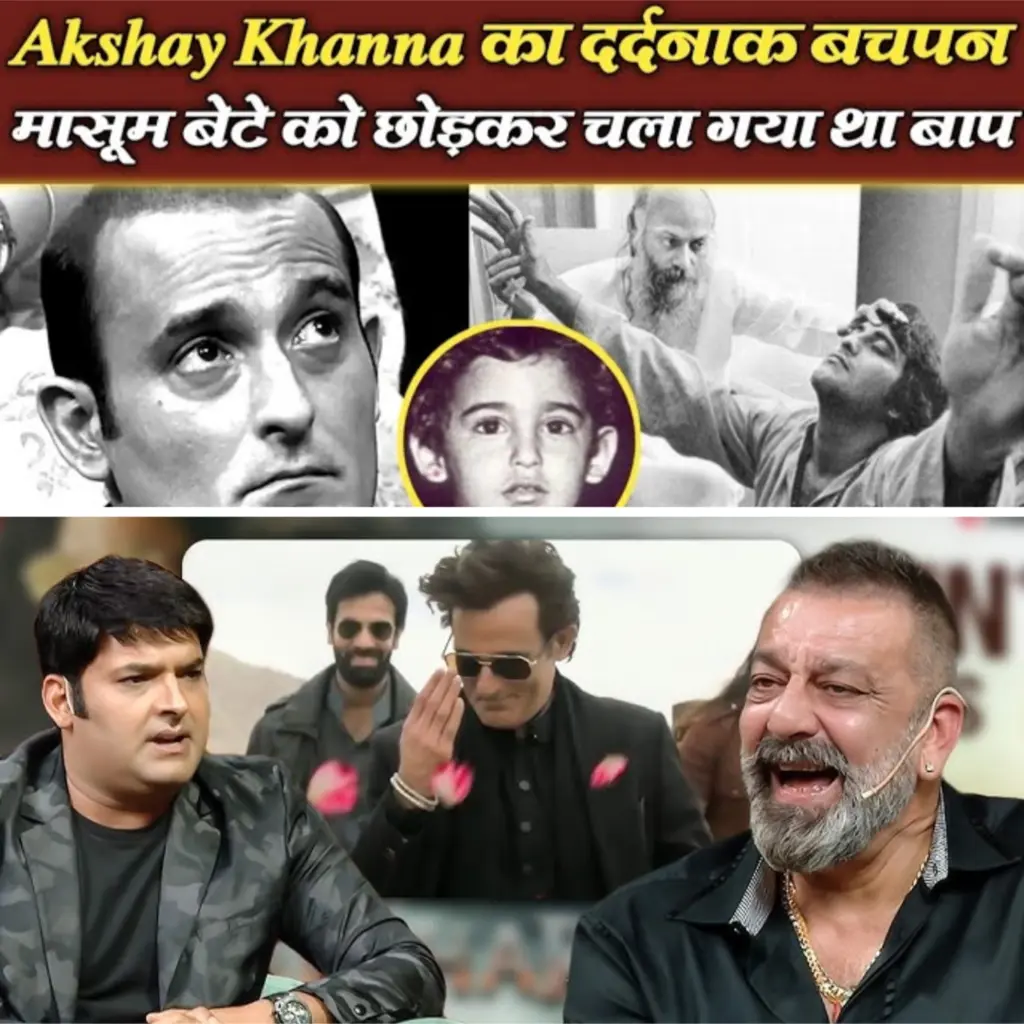
No Father’s Shadow, No Luck, No Love: The Untold Story of Akshaye Khanna
In Bollywood, a surname can open doors before talent ever speaks.
Akshaye Khanna was born with one of those surnames.
The son of Vinod Khanna, a man whose presence once commanded screens and crowds alike, Akshaye entered the world with expectations already written for him. Stardom was assumed. Privilege was presumed. Protection was expected. Yet, as his life unfolded, something felt strangely absent.
Noise.
There were no dramatic launches built on hype. No aggressive grooming for superstardom. No visible safety net catching him when momentum slowed. What followed instead was a career marked by silence, gaps, and a quiet intensity that never quite fit Bollywood’s obsession with constant visibility.
From the beginning, Akshaye Khanna seemed different.
Where others chased attention, he avoided it. Where peers built personas, he dismantled them. Interviews were sparse. Public appearances carefully limited. Even success arrived without celebration. His performances were praised, sometimes deeply admired, yet he remained distant from the machinery that turns actors into brands.
Many assumed this was confidence.
Others mistook it for arrogance.
Few considered the possibility that it was something else entirely.
Despite being Vinod Khanna’s son, Akshaye did not grow up under a comforting cinematic shadow. His father’s life was complex, marked by fame, spiritual withdrawal, political shifts, and long absences. The relationship between father and son was never publicly dramatized, but it carried a quiet distance that Akshaye himself never denied.
He inherited the name, but not the guidance.
In an industry where lineage often means mentorship, influence, and protection, Akshaye’s path felt oddly solitary. He entered films not as a prince escorted into the kingdom, but as an observer stepping carefully into unfamiliar territory.
His debut showed promise. Critics noticed his restraint, his intelligence, his refusal to overperform. Audiences sensed depth. Directors saw reliability. Everything suggested a steady rise.
Yet just as often, he disappeared.
Years passed between films. Momentum dissolved without explanation. Roles that could have cemented stardom arrived sporadically, sometimes too late, sometimes without the support they deserved. While contemporaries expanded their presence through endorsements, relationships, and constant reinvention, Akshaye remained still.
Bollywood does not reward stillness.
Rumors filled the silence. Some said he lacked ambition. Others whispered about insecurity. A few speculated about health, emotional withdrawal, or an inability to adapt to the industry’s social demands. But Akshaye never confirmed, never denied.
He simply chose not to speak.
Perhaps the most striking absence in his life story is love, at least the version Bollywood celebrates. No high profile relationships. No public heartbreaks. No marriage announcements. No carefully curated romance to humanize him for fans.
In an industry where love stories often sustain relevance as much as films, Akshaye’s emotional privacy felt almost radical.
Was it choice or consequence?
Those close to him describe a man deeply introspective, uncomfortable with emotional exhibition. Someone who values solitude not as escape, but as necessity. Yet solitude, when sustained long enough, begins to blur the line between preference and isolation.
And that is where his story becomes unsettling.
Akshaye Khanna had talent. That was never in question. He delivered performances that lingered long after credits rolled. Roles that revealed vulnerability without melodrama. Intelligence without arrogance. Pain without noise.
Yet talent alone rarely sustains a career in Bollywood.
Luck matters. Timing matters. Networks matter. Visibility matters. And in each of these, Akshaye seemed perpetually misaligned.
When he stepped back, the industry moved on quickly. There were always others ready to fill space. When he returned, audiences welcomed him warmly, but without the urgency reserved for stars who never leave. He existed in a strange in between, admired but not chased, respected but not protected.
And still, he did not fight it.
There were no complaints. No public grievances. No attempts to rewrite narratives. He did not blame fate, family, or industry politics. He accepted the rhythm life handed him, even when it seemed unfair.
That acceptance is both admirable and heartbreaking.
Because it raises a question Bollywood rarely confronts. What happens to those who do not play the game, even when they have every qualification to win?
Akshaye Khanna’s life contradicts the fantasy of inherited advantage. It reveals that lineage without alignment, talent without hunger for spotlight, and dignity without noise can leave a person stranded between success and solitude.
He was never rejected outright.
He was simply never fully embraced.
As audiences revisit his films today, many notice something they missed before. A quiet sadness behind controlled expressions. A sense of emotional restraint that feels lived, not performed. Characters who seem to carry loneliness with familiarity.
Perhaps art imitates life more honestly than interviews ever could.
Akshaye Khanna never asked for sympathy. He never positioned himself as misunderstood. But his journey invites reflection, especially in an industry that equates worth with visibility and love with validation.
Not everyone wants the spotlight.
But not everyone survives without it either.
In the silence Akshaye chose, or was forced to accept, lies a story that challenges Bollywood’s loud definitions of success. A story about inheritance that did not protect, fame that did not fulfill, and love that never arrived in public form.
This is not a tragedy.
But it is not a fairytale either.
It is the story of a man who walked alone through a world designed for crowds, carrying his name, his talent, and his unanswered questions with equal restraint.
And as his life continues away from constant attention, one thought remains difficult to ignore.
Sometimes, the heaviest roles are the ones lived off screen.
In Bollywood, absence is rarely forgiven.
For Akshaye Khanna, absence became a pattern.
Just when audiences began to recognize his face and critics acknowledged his depth, he stepped back. Not once, but repeatedly. Each disappearance sparked confusion. Each return felt almost accidental, as if he had wandered back into cinema rather than chased it.
The industry noticed.
Producers prefer reliability that extends beyond performance. They want presence at events, relationships with the press, willingness to network, and a hunger that can be marketed. Akshaye offered none of that. He delivered his lines with precision, then vanished into privacy.
In an ecosystem built on constant momentum, this was risky.
Some insiders quietly labeled him difficult. Not because of behavior, but because of unpredictability. Others saw him as unambitious, a man unwilling to leverage his surname fully. The truth, however, seemed more complicated than either accusation.
Akshaye never appeared bitter about missed opportunities. He did not compete for space. He did not chase validation. Instead, he maintained a measured distance that suggested inner conflict rather than professional failure.
Those long gaps between films were not filled with endorsements, interviews, or reinventions. They were filled with silence.
That silence carried a cost.
As newer actors emerged, Akshaye’s name slowly drifted out of active conversations. Offers reduced. Scripts changed. His relevance became conditional on nostalgia rather than immediacy. Even when he returned with powerful performances, the industry treated them as pleasant surprises rather than evidence of sustained worth.
He was praised, but rarely pursued.
There were moments when his career could have shifted dramatically. Roles that demanded emotional intelligence rather than spectacle suited him perfectly. When he appeared in such films, audiences were reminded of what he could do. Yet instead of capitalizing on renewed attention, he stepped away again.
To many, this felt self sabotaging.
Why walk away when recognition finally arrives?
The answer may lie in the emotional cost of staying.
Bollywood rewards those who surrender privacy. It demands accessibility, narrative alignment, and emotional exposure. For someone like Akshaye, deeply private and introspective, this environment can feel invasive. The price of success is often the erosion of personal boundaries.
Akshaye seemed unwilling to pay that price.
But boundaries, while protective, can also isolate.
Without romantic partnerships to anchor him publicly, without family alliances actively guiding his career, and without aggressive self promotion, Akshaye existed on the margins of an industry he clearly respected but never fully belonged to.
His choices raised uncomfortable questions about masculinity in Bollywood. While vulnerability is celebrated onscreen, emotional restraint offscreen is often misunderstood. A man who does not perform ambition, romance, or dominance is quickly labeled irrelevant.
Akshaye challenged that narrative simply by existing differently.
Yet difference does not guarantee safety.
There were whispers of loneliness. Observations of withdrawal. Speculation about internal struggles that never reached public confirmation. Akshaye did not feed these stories. He allowed ambiguity to surround him, perhaps believing that explanation would compromise authenticity.
In doing so, he lost control of the narrative.
Silence invites interpretation, and interpretation rarely favors complexity.
As the years passed, Akshaye’s presence felt more deliberate. He chose roles carefully, often supporting characters rich in nuance rather than leading roles demanding constant exposure. His performances grew sharper, more internal, as if mirroring his own emotional economy.
Critics began calling him an actor’s actor.
A compliment that often arrives when superstardom has already slipped away.
Yet even then, Akshaye did not express regret. There were no interviews lamenting missed chances. No public reflections on what could have been. If disappointment existed, it remained private, guarded like everything else in his life.
This restraint made him admirable to some and distant to many.
Because Bollywood thrives on confession.
Stars are expected to narrate their pain, their love, their ambition, and their healing. Akshaye refused this ritual. He offered craft instead of confession. Presence instead of personality.
And the industry responded accordingly.
He was respected, but not centered.
He was valued, but not prioritized.
He was remembered, but not followed.
The cost of stepping away repeatedly became clear over time. His career no longer defined him, and perhaps that was intentional. Yet for audiences who sensed depth and wanted more, his absence felt like a loss not just for him, but for cinema itself.
Akshaye Khanna’s journey forces an uncomfortable reflection.
What happens when a person values inner stability more than external success?
Is withdrawal a form of self preservation, or a slow surrender to invisibility?
The line between the two is thin.
And Akshaye walked it quietly.
As he aged, the industry aged too. Trends shifted. Attention spans shortened. Yet when he appeared, something familiar returned. A calm intensity. A refusal to overstate emotion. A presence that did not beg to be seen.
In a world addicted to noise, his restraint felt almost defiant.
But defiance without allies can be lonely.
By choosing distance, Akshaye protected himself from compromise, but also from continuity. He survived on his own terms, but those terms came with isolation.
Whether that isolation was chosen or endured remains unclear.
Perhaps even to him.
As his career settled into selective appearances, one reality became undeniable.
Akshaye Khanna did not lose Bollywood.
He simply never held onto it the way others did.
And in that choice, conscious or not, lies both his dignity and his quiet sorrow.
As time moves forward, something unusual happens to actors who step away from the spotlight.
They are either forgotten, or they are slowly reinterpreted.
Akshaye Khanna belongs to the second kind.
Today, when his name resurfaces, it does not arrive with frenzy. It arrives with respect. Clips of his performances circulate online. Dialogues are revisited. Expressions are studied. Younger audiences discover him not through publicity, but through scenes that feel startlingly real even years later.
In a strange way, distance has preserved him.
While many of his contemporaries battled reinvention, relevance, and the exhaustion of constant exposure, Akshaye aged quietly. He did not dilute himself through over familiarity. He did not explain his choices into insignificance. He allowed mystery to remain, even when it worked against him.
That mystery is now his legacy.
Akshaye Khanna will likely never be remembered as a superstar in the traditional sense. He did not dominate box offices. He did not define an era through numbers or mass hysteria. His legacy lives elsewhere, in the pauses between words, in the restraint of emotion, in characters that felt inhabited rather than performed.
He became a reference point, not a headline.
There is a particular sadness in that, but also a rare integrity.
Because fame, when chased relentlessly, often demands compromise. It reshapes personalities, simplifies emotions, and rewards repetition. Akshaye refused that process. He did not reduce himself to remain visible. He did not bargain with his discomfort to stay relevant.
Instead, he accepted a quieter truth.
That success does not always look like dominance.
That love does not always arrive publicly.
That fulfillment may exist outside applause.
This does not mean his journey was painless.
The absence of a public family life, the lack of a partner by his side, the long silences between appearances, all suggest a man who carried solitude as both shield and burden. Bollywood celebrates companionship, whether romantic or professional. Akshaye navigated largely alone.
And loneliness, even when chosen, leaves marks.
Yet there is no bitterness in how he is remembered.
Colleagues speak of his professionalism. Directors recall his discipline. Critics admire his intelligence. Audiences sense sincerity. These are not the rewards of hype. They are the rewards of honesty.
In recent years, his selective returns have felt deliberate, almost philosophical. He appears when the role demands depth, not attention. When silence can speak louder than spectacle. When presence matters more than promotion.
It is as if he finally aligned life with temperament.
Akshaye Khanna’s story challenges one of Bollywood’s most sacred beliefs. That more visibility always means more success. That louder equals better. That ambition must be performed to be real.
He proved otherwise.
He lived a career where restraint was mistaken for retreat, and solitude was read as weakness. Only with time has it become clear that his withdrawal was not failure, but refusal.
Refusal to become someone he was not.
Refusal to monetize his private life.
Refusal to sell emotional access for relevance.
In doing so, he paid a price. But he also retained something rare.
Self ownership.
There is no dramatic redemption arc here. No late life reinvention designed to rewrite history. Akshaye Khanna does not seek to be redefined. He allows his work to age naturally, trusting that sincerity outlasts noise.
And perhaps that is the most unsettling part of his story.
He did not fight for love, luck, or legacy the way the world expected him to. He accepted what came, declined what did not fit, and carried on without explanation.
In a culture obsessed with narrative control, that is radical.
So when people say Akshaye Khanna had no father’s shadow, no luck, no love, they may be missing something essential.
He had choice.
And he used it quietly.
His life reminds us that not every story needs triumph to be meaningful. Some stories matter because they resist spectacle. Because they show that a person can exist fully without becoming a symbol, a scandal, or a myth.
Akshaye Khanna did not win Bollywood.
He did not lose himself to it either.
And in the end, that balance may be his most honest success.
The screen fades.
The silence remains.
And for once, the silence feels complete.