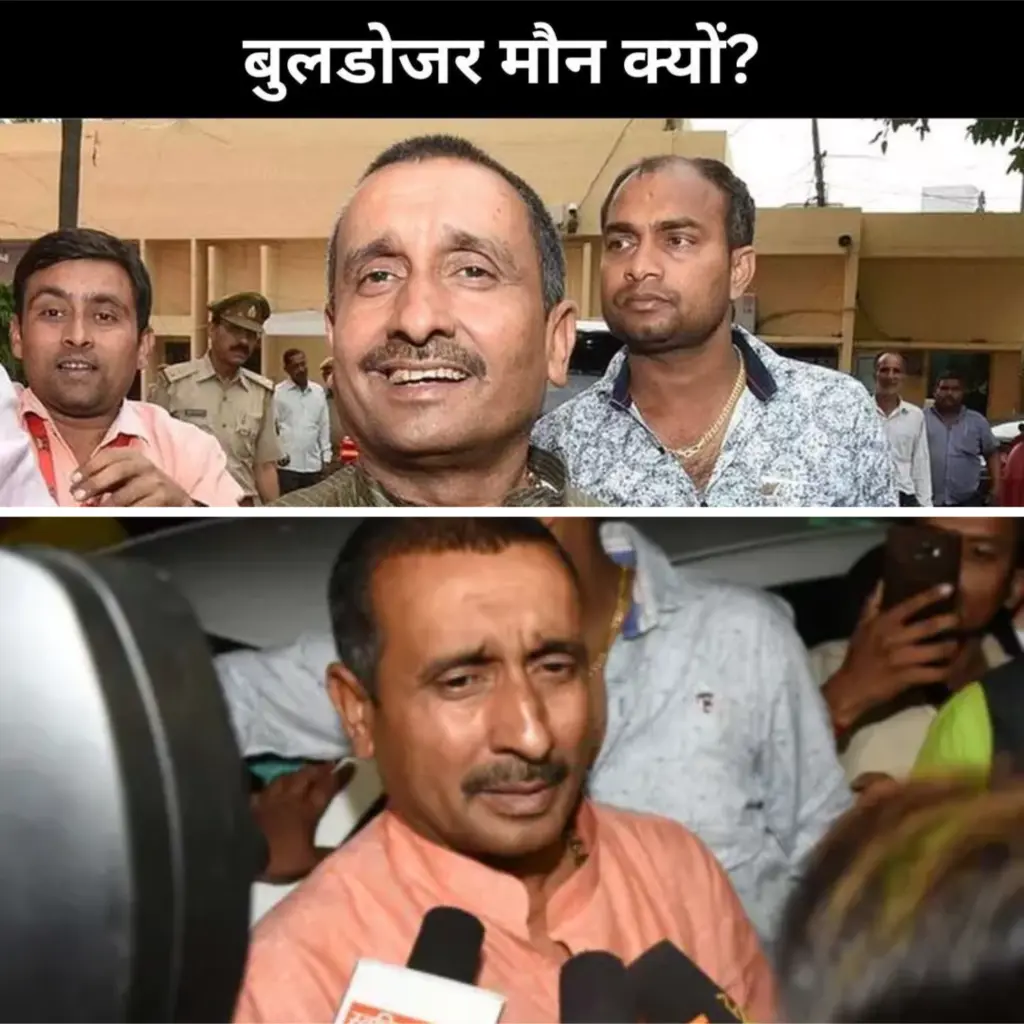
Bulldozer Action at Kuldeep Singh Sengar’s House Sparks Political Shockwaves in Unnao
The morning Unnao woke up to the sound of a bulldozer, it was not just concrete that trembled. Memory did too.
For years, the name Kuldeep Singh Sengar has carried the weight of one of India’s most disturbing criminal cases. A former strongman politician. A once powerful MLA. A man who moved through corridors of influence with confidence that few dared to challenge. Today, he sits behind prison walls, serving life imprisonment. Yet on this day, the spotlight returned not to the courtroom, but to his house.
As the bulldozer rolled forward, dust rose into the air, thick and unforgiving. Locals gathered at a distance. Some watched in silence. Some recorded on their phones. Some whispered a single question again and again. Why now?
The Unnao case never truly left the public conscience. It lingered like an unresolved ache, resurfacing whenever justice felt delayed or incomplete. For many, the bulldozer symbolized something long awaited. Not revenge. Not celebration. But a visible moment that said power does not always get the final word.
Chief Minister Yogi Adityanath’s government has, over the years, built a reputation around decisive action. Supporters call it firm governance. Critics call it spectacle. But there is no denying the emotional impact of visible enforcement. When the state acts publicly, it sends a message far beyond legal paperwork.
This was not merely the demolition of a structure. It was the collapse of an image that once projected invincibility. A reminder that political stature, however high, can fall under the weight of law.
For the survivor of the Unnao case, whose name is often overshadowed by headlines about power and politics, moments like these reopen wounds. Justice in India is rarely swift. It comes in fragments. A verdict here. A sentence there. A symbolic act years later. Each step carries emotional consequences that statistics and legal language cannot capture.
As the walls came down, many asked whether this action was administrative or symbolic. Was the property illegal? Was the timing coincidental? Or was it carefully chosen to reinforce a narrative of zero tolerance?
The government insists on legality. Procedures. Notices. Compliance. Yet the public sees images, not files. A bulldozer has become more than a machine in Uttar Pradesh. It has become a political language. One that speaks loudly, whether one agrees with it or not.
In Unnao, that language echoed deeply.
Older residents remembered the days when Kuldeep Singh Sengar’s influence was unquestioned. When his name alone could silence opposition. When fear, not law, dictated outcomes. For them, the sight of demolition was surreal. Not triumphant, but unsettling in its finality.
Younger onlookers saw something else. A lesson. A warning. A signal that the era of unchecked privilege might finally be cracking.
Yet skepticism remains. Some voices ask whether justice should look like this. Whether visibility replaces fairness. Whether selective action risks turning law enforcement into performance. These questions refuse to fade, hanging in the dust-filled air long after the machines stop.
The Unnao case has always been about more than one man. It exposed uncomfortable truths about power, protection, and the cost of speaking up. Each development, no matter how dramatic, must be measured against that larger reality.
As evening approached and the machinery slowed, what remained was not just rubble. It was a reminder that justice in India is a long, uneven road. Sometimes it arrives in courtrooms. Sometimes it arrives years later, roaring on steel tracks, forcing the nation to look again.
And Unnao, once more, was watching.
As news of the demolition spread beyond Unnao, reactions poured in from every corner of the country. Television studios lit up. Social media timelines flooded with split opinions. For some, the bulldozer represented long-delayed justice finally taking physical form. For others, it raised uncomfortable questions about power, precedent, and the future of law enforcement in a democracy.
Chief Minister Yogi Adityanath did not need to issue a long statement. The image itself spoke. Under his leadership, the bulldozer has evolved into a signature of governance, a visual shorthand for zero tolerance. Supporters see it as fear finally shifting sides, from victims to perpetrators. They argue that when the system acts visibly, it restores public faith that had been eroded by years of delay and compromise.
But critics are not silent.
They ask whether justice should be loud. Whether law should arrive with cameras already rolling. They point out that punishment is meant to follow due process, not public sentiment. In their view, the danger lies not in one demolition, but in normalizing spectacle as governance. Once symbolism overtakes legality, they warn, the line between justice and intimidation begins to blur.
The Unnao case amplifies this tension because of its history. This was not a crime hidden in shadows. It unfolded in full public view, marked by alleged intimidation, political shielding, and a survivor who had to fight relentlessly just to be heard. For years, the system appeared slow, cautious, almost afraid. That memory makes today’s decisive visuals feel both satisfying and unsettling.
On the streets of Unnao, conversations are quieter but heavier. Shopkeepers speak in lowered voices. Some say the action was inevitable. Others admit they never thought they would live to see it. The fall of a powerful figure’s property shakes local hierarchies that once felt permanent. Fear changes direction, and that shift leaves people unsure of what comes next.
For the survivor, every new headline carries a double weight. There is validation in seeing the powerful held accountable, even symbolically. But there is also exhaustion. Justice that arrives in fragments over years forces survivors to relive trauma repeatedly. Each “big moment” reopens wounds that never fully healed.
Legal experts weigh in with careful language. They stress that demolition must stand on solid administrative grounds. If it does, the action holds. If not, it risks being challenged, turning symbolism into vulnerability. In courts, images matter less than documents. But outside, perception often wins the louder battle.
And perception is powerful.
The bulldozer has become a mirror. Supporters see strength reflected back. Critics see excess. Neutral observers see a state experimenting with a new grammar of authority, one that relies on visuals to convey resolve. Whether history judges this grammar as effective or dangerous remains uncertain.
What is certain is that the Unnao case refuses to fade quietly. It resurfaces whenever the country debates power, punishment, and protection. Each development becomes a test of whether India can balance emotional justice with constitutional discipline.
As night fell on Unnao, the debris lay still. The cameras moved on. But the questions did not. They lingered in drawing rooms, court corridors, and political war rooms alike.
Was this the closing chapter, or just another dramatic pause?
Because in cases like Unnao, justice is never just about what is destroyed. It is about what is built afterward. Trust. Fear. Precedent. Or perhaps, something far more fragile.
Long after the bulldozer left Unnao, its echo continued to travel far beyond the broken walls. This moment was never just about Kuldeep Singh Sengar or a single property. It became a symbol, carefully observed by politicians, administrators, victims, and citizens alike, all asking the same quiet question. What does justice look like now?
For the Yogi Adityanath government, the message was unmistakable. Power would no longer guarantee protection. Influence would no longer rewrite consequences. The bulldozer was meant to draw a hard line between the past and the present. Supporters argue that such clarity was overdue, that fear once lived only with victims, and now it has been redirected toward those who believed themselves untouchable.
Yet symbols have long shadows.
Once the dust settles, the legal system must still answer for fairness. If justice becomes selective, it risks losing moral authority. If it becomes performative, it risks replacing rule of law with rule of optics. These concerns are not theoretical. They will shape how future governments act, how officials enforce laws, and how citizens interpret state power.
The Unnao case stands as a painful reminder of how difficult accountability can be when power and crime intersect. The survivor’s fight was not just against one man, but against a system slow to listen. Any action taken in this legacy must be weighed against that truth. Justice should not only punish the guilty, it must protect the vulnerable before harm occurs.
In political circles, the demolition has already entered campaign language. Allies cite it as proof of decisive leadership. Opponents warn of dangerous precedent. Somewhere between those positions lies the real impact. A society learning, slowly and imperfectly, how to balance emotion with law.
For Unnao itself, the moment leaves a complex inheritance. Fear has shifted, but it has not disappeared. It has simply changed shape. Residents now understand that authority can fall, but they also wonder how stable the rules truly are. Stability, after all, comes not from force alone, but from trust.
History will remember this image not in isolation, but as part of a larger story. A story about delayed justice. About public pressure. About a state experimenting with visibility as power. Whether this chapter strengthens faith in institutions or weakens it will depend on what follows next.
Because justice is not proven by one dramatic act. It is proven by consistency. By restraint. By ensuring that the law remains stronger than the spectacle built around it.
In Unnao, one house fell. But the real test is still standing.
And India is watching.