Ranu Mondal’s Viral Video Sparks Outrage — The Truth Behind the Clip
When the latest clip of Ranu Mondal began circulating on social media, the reaction was instantaneous — shock, confusion, disbelief, and then, a tidal wave of questions. This wasn’t the polished studio footage of the singer whose voice once stopped the country in its tracks, nor was it a glamorous performance on a grand television stage. Instead, it was a raw, unfiltered glimpse into a moment that left millions of fans asking: Where has she gone? What really happened to the woman we once hailed as an overnight sensation?
To understand the impact of that viral clip, you have to rewind to the summer of 2019. What began as a simple cellphone recording of a woman singing on a railway platform in Ranaghat, West Bengal, became a phenomenon that captivated the entire nation. In that first video, Ranu stood barefoot before the crowds, her voice rich and soulful as she sang Ek Pyaar Ka Nagma Hai, a classic immortalized by the legendary Lata Mangeshkar. The video spread like wildfire, garnering millions of views and propelling an unknown street singer into the hearts of millions.
Overnight, Ranu Mondal became a symbol of hope and unexpected transformation — a Cinderella story in the digital age. Her voice, once only heard by those waiting at train platforms, now echoed across social media, television screens, and professional recording studios. Himesh Reshammiya, a prominent Bollywood composer, invited her to record songs for his film Happy Hardy and Heer after being moved by her talent. Offers for reality TV appearances and interviews followed; for a moment, it seemed as though the world had finally opened its doors to her.
But fame, as so many viral sensations discover, can be fickle.
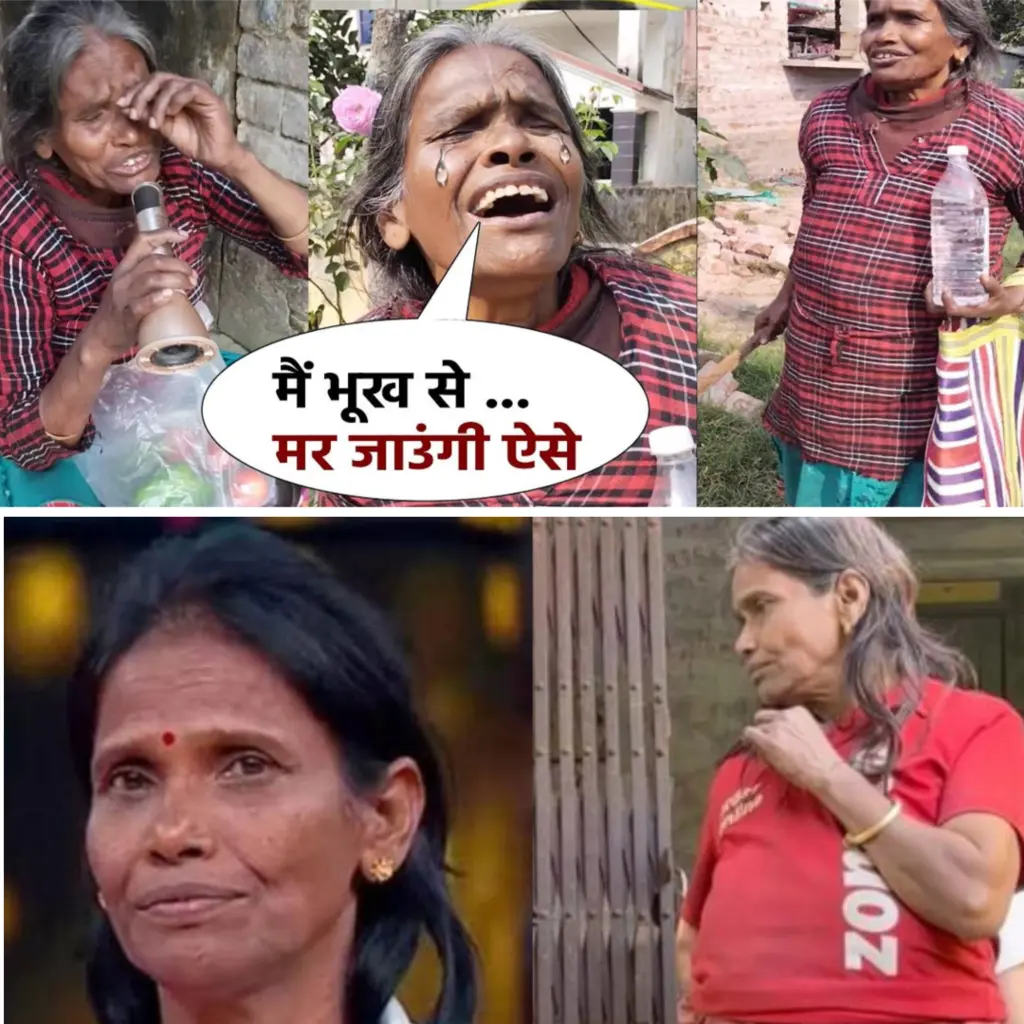
Fast forward to the present, and the latest video is starkly different. In the clip that shocked fans, Ranu is seen standing almost motionless in a plain Zomato T-shirt, her expression distant, vacant. Gone is the aura of musical promise — replaced by a sight that left many wondering if the world had forgotten her just as quickly as it had embraced her.
The contrast was jarring. Only a few years earlier, she had been celebrated as a voice so pure it seemed lifted straight from the realm of myth. Now, the conversation online shifted from admiration to concern. Fans who once cheered her rise watched the clip with furrowed brows, debating what it meant and how a woman who once stood on the precipice of greatness could appear so lost.
The shock wasn’t just about what was visible on screen — it was about the story it hinted at, a story of promise unfulfilled, of dreams colliding with reality, and of a world that sometimes lifts people up only to let them fall back into obscurity. It was the kind of moment that tore at the heart, precisely because Ranu’s journey had once inspired hope in so many.
Younger audiences, especially those who had never witnessed her first viral rise, saw only the latest video and wondered — Is she okay? Is she struggling? Did something go wrong? Older fans immediately remembered her meteoric success and the subsequent silence that followed. They recalled how intensely social media had rallied around her, cheering every small triumph. And yet now, there she was again, but in a context that felt so starkly ordinary, almost forlorn.
Behind the scenes, the truth is far more complex than one clip can capture. Ranu’s brief stint in the spotlight brought opportunities, but it also exposed her to the harsh pressures of public life. Some media accounts suggest that sustaining momentum in a fickle entertainment industry proved challenging, while others point to the absence of long-term support systems for viral stars once the initial excitement fades.
Fans who dug deeper into recent footage and visits painted an even more poignant picture. Reports from those who sought her out in her hometown described living conditions that were stark and disheartening — far removed from the glamour and attention of her peak fame. While these accounts can’t fully define her present reality, they contribute to the fuller, more human story behind the viral images.
Amid the speculation and commentary, a quieter narrative was emerging — one about the emotional toll that sudden fame and equally sudden withdrawal can take on a person. For a brief window, Ranu had been adored, spotlighted, and elevated onto platforms she had never imagined. And then, almost as quickly as the internet discovered her, it appeared to move on to its next sensation.
Fans shared memories of her performances, clips of her singing various songs from Manike Mage Hithe to Bachpan Ka Pyaar, moments that once delighted audiences and reminded them of her musical gift.
Many of these videos had once inspired viral memes, remixes, and enthusiastic praise — or sometimes cruel mockery — but they all served as reminders of a time when Ranu’s voice pulled people together rather than dividing opinion.
Some longtime supporters took to social media to lament how fleeting digital fame can be. They spoke of how Ranu had given them goosebumps the first time they heard her voice, how they had shared her videos with friends and family, how they had cheered for her ascent. And now, confronted with this new clip, they voiced a collective sense of sadness that the world’s gaze had shifted.
Yet amid the shock and speculation, there was also deep compassion. People began to ask: What support does she need? How can fans help? Some suggested charitable outreach or calling attention to her well-being. Others pointed out that the entertainment industry should offer more guidance and mental health support to those thrust into sudden visibility.
And then came the voices urging caution — not to rush to judgment based on a single clip, not to assume the worst, and to remember that viral moments rarely tell the whole story. They reminded the public that behind every image is a person with dignity, history, struggles, and untold chapters yet to be written.
For many fans, the latest viral clip of Ranu Mondal was not just a shocking moment — it was a mirror. It reflected the digital age’s unpredictable nature, the way fame can lift someone high and then drop them back into a quiet corner of life. It reminded viewers of the fragility of online attention and the real human hearts behind the screens they scroll past every day.
Some still hold onto hope that this moment will be more than a footnote — that it might spark a renewed conversation about how society treats those it elevates so rapidly. Others simply hope for dignity, kindness, and meaningful opportunities for Ranu, wherever life takes her next.
Because whether she’s standing on a grand stage or quietly singing in a corner of her hometown, the voice that once captivated millions deserves to be heard — not just remembered for one viral moment, but appreciated for the deeper story of resilience, beauty, and heart behind it.
As the clip continued to circulate, the internet did what it always does best — it reacted loudly, emotionally, and often without pause. Within hours, Ranu Mondal’s name once again trended across platforms, but this time the tone was different. It was no longer about celebration or discovery. It was about concern, judgment, nostalgia, and an uncomfortable sense of collective responsibility.
Comments flooded in from every corner of the digital world. Some fans expressed heartbreak, writing that they could barely recognize the woman whose voice once made them stop scrolling mid-feed. Others questioned why the industry that once embraced her so warmly now seemed absent. “We made her famous,” one comment read, “and then we moved on.” That single sentence echoed the unease many felt but struggled to articulate.
Not all reactions were kind. As with many viral figures, Ranu once again became the subject of harsh memes and insensitive jokes. Critics dissected her appearance, her expression, even the clothes she wore in the clip, turning a deeply human moment into content for entertainment. For long-time supporters, this was perhaps the most painful part — watching empathy get drowned out by mockery.
Yet beneath the noise, a quieter but more meaningful conversation began to emerge.
Several voices, including journalists and social commentators, started revisiting Ranu’s rise to fame and asking uncomfortable questions. What happens to people who go viral without preparation, protection, or long-term support? What responsibility do audiences and platforms carry when they elevate someone overnight and then abandon them just as quickly?
Ranu’s journey, many argued, was not a failure of talent, but a failure of structure. She was discovered, celebrated, and showcased, but never truly sustained. The machinery of fame moved on, leaving her to navigate its aftermath largely alone. In this context, the viral clip stopped being a shock and became a symptom.
People who claimed to have met Ranu recently offered mixed but revealing accounts. Some said she still sings occasionally, her voice unchanged when she feels safe and comfortable. Others noted that she appears withdrawn, cautious, and wary of attention — a stark contrast to the woman who once stood confidently before cameras and crowds. Fame, it seemed, had given her visibility but taken something equally precious in return.
Social media users began sharing throwback clips of her earlier performances, not as mockery, but as remembrance. Videos of her singing classic melodies resurfaced, accompanied by captions filled with longing. “This is how I remember her,” many wrote. “This is the Ranu who gave me goosebumps.” These posts carried a quiet grief, as if fans were mourning not a person, but a lost moment in time.
Amid this wave of reflection, calls for compassion grew stronger. Some fans urged others to stop speculating about her mental health or personal struggles based on fragments of footage. They reminded viewers that a single clip can never capture the fullness of someone’s life. Others called for tangible help — not charity rooted in pity, but dignity rooted in respect.
Interestingly, a few industry insiders also spoke up, albeit cautiously. They acknowledged that viral fame often creates unrealistic expectations, both for audiences and for the individuals at the center of it. Without consistent mentorship, financial guidance, or emotional support, many viral stars struggle to adapt once the spotlight dims. Ranu’s story, they suggested, should be a lesson — not an exception.
What made this moment different from previous waves of attention was the tone of reflection. Instead of asking, “Why did she fade?” people began asking, “How could this have been handled better?” That shift, though subtle, felt important.
For Ranu herself, silence remained her strongest response. She did not rush to clarify, explain, or defend herself. There were no emotional posts, no public statements, no attempts to reclaim attention. And perhaps that silence said more than words ever could. It suggested exhaustion. Or caution. Or simply a desire to live beyond the constant gaze of strangers.
Still, hope lingered.
Some fans expressed belief that this renewed attention, if handled with care, could open doors again — not necessarily to fame, but to stability and respect. Others hoped it would at least spark a broader conversation about how society treats those who rise from vulnerable circumstances into sudden visibility.
Because at the heart of this story is not just Ranu Mondal, the singer, but Ranu Mondal, the human being.
Her viral clip did not shock fans because it was sensational. It shocked them because it was quiet. Because it forced people to confront the uncomfortable truth that inspiration stories do not always end neatly. That talent does not guarantee protection. And that the internet, for all its power, is often fleeting in its loyalty.
As the noise gradually settles, one question remains unanswered, hanging gently in the air. Not “What went wrong?” but “What do we do now?”
For some, the answer is simple — to remember her voice, her courage, and the moment she reminded millions that magic can appear in the most unexpected places. For others, it is a call to be kinder, slower to judge, and more mindful of the real lives behind viral moments.
And for Ranu Mondal, wherever she stands today, perhaps the most important thing is not whether the world is watching again, but whether it has finally learned to look with empathy.
https://youtu.be/p3mW6rM9GVY
By the time the viral wave began to slow, something subtle but significant had changed. Ranu Mondal’s latest clip was no longer just a piece of content being passed from screen to screen. It had become a moment of reckoning — not only for her story, but for the culture that created it.
Viral fame has always promised miracles. It tells people that talent will be found, that destiny only needs the right algorithm, that one video can rewrite an entire life. For a brief moment in 2019, Ranu Mondal embodied that promise perfectly. She was the proof people pointed to when they said dreams still happen. A woman with nothing but a voice stood on a railway platform and sang her way into the nation’s heart.
But years later, the promise feels more complicated.
Ranu’s journey reveals a truth many prefer to ignore. Visibility is not the same as security. Applause is not the same as care. And being celebrated does not mean being protected. The internet can elevate someone in seconds, but it rarely stays long enough to help them build a future.
In Ranu’s case, the spotlight arrived suddenly and without instruction. There were cameras, interviews, recording studios, and expectations she had never been trained to carry. She was expected to transform instantly — from a woman surviving day to day into a public figure with polish, discipline, and resilience. When she struggled, as many would, patience ran out faster than compassion.
What followed was silence, and then distance.
The latest viral clip reopened that silence like an old wound. It reminded people that stories do not end when the headlines stop. Life continues quietly, often without applause. And for those who rise from fragile circumstances, the fall back into anonymity can be heavier than anyone imagines.
Yet within that discomfort lies an important lesson.
Ranu Mondal’s story forces audiences to reconsider their role. Watching is easy. Sharing is easy. Moving on is easiest of all. But empathy requires staying, listening, and resisting the urge to turn human struggle into spectacle. It asks people to slow down and see individuals not as content, but as lives unfolding in real time.
There is also a lesson for the entertainment industry itself. Discovering talent is only the beginning. Without mentorship, long-term planning, emotional guidance, and financial stability, sudden fame can do more harm than good. Ranu was celebrated for her voice, but little was done to prepare her for the world that came with it. Her experience mirrors that of many viral sensations who shine briefly and then disappear, not because they lack ability, but because the system around them fails to hold them.
Still, her story is not finished.
Despite everything, those who have heard Ranu sing recently say something remarkable remains unchanged. When she feels safe, when she is not being filmed or judged, her voice still carries the same haunting sincerity. It may no longer command millions of views, but it holds the same emotional truth it always did. And perhaps that is where her future lies — not in reclaiming fame, but in reclaiming agency.
Some believe there is still space for her to find stability through music, whether through small performances, community support, or quieter platforms that value artistry over virality. Others believe her path may move away from the spotlight entirely, toward a life defined not by attention, but by peace. Either possibility deserves respect.
What matters most is that her worth is not measured by trends.
Ranu Mondal does not owe the world another viral moment. She does not owe explanations, performances, or comebacks. Her contribution has already been made in the way her voice once united strangers, in the way her story briefly reminded millions that beauty can emerge from overlooked corners.
If the world has learned anything from her journey, it should be this. Talent can be discovered in seconds, but humanity must be protected for a lifetime. Fame is not kindness. Attention is not care. And inspiration stories are not complete unless the people inside them are allowed to remain whole.
As the internet moves on to its next sensation, Ranu’s name may fade again from trending lists. But for those who truly listened — not just to her voice, but to what her rise and fall reveal — her story lingers.
It lingers as a reminder to be gentler with those we elevate. To question systems that celebrate without sustaining. And to remember that behind every viral clip is a human being, breathing, hoping, and trying to survive the weight of being seen.
Wherever Ranu Mondal is today, whether singing softly to herself or living quietly away from cameras, one truth remains. Her story was never just about fame. It was about vulnerability meeting opportunity — and what happens when the world looks away too quickly.
And perhaps, in remembering her with empathy rather than spectacle, the world can finally give her something more lasting than applause.